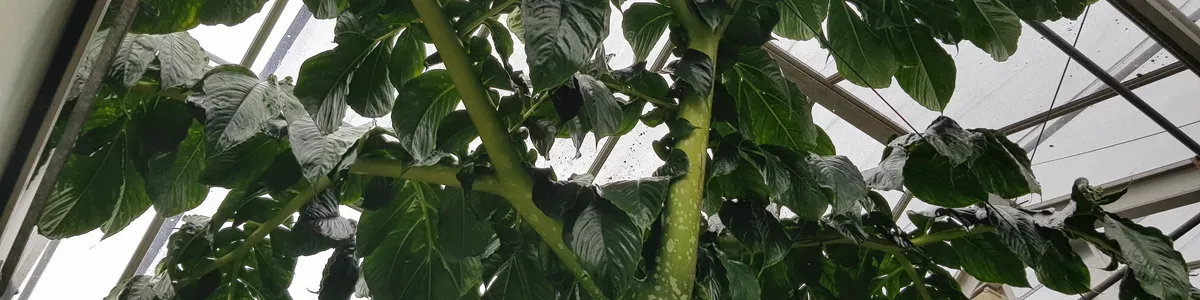
While many people have seen - and smelled - the eye-catching inflorescence at botanic garden displays, they may be unaware of the plant's alternate phase: the leaf cycle.
Titan Arum's leaf cycle is a hugely important part of the plant's life cycle.
This annual event happens many times in a single plant's life, and it can take as many as ten years to shift from a leaf cycle to a flower cycle.
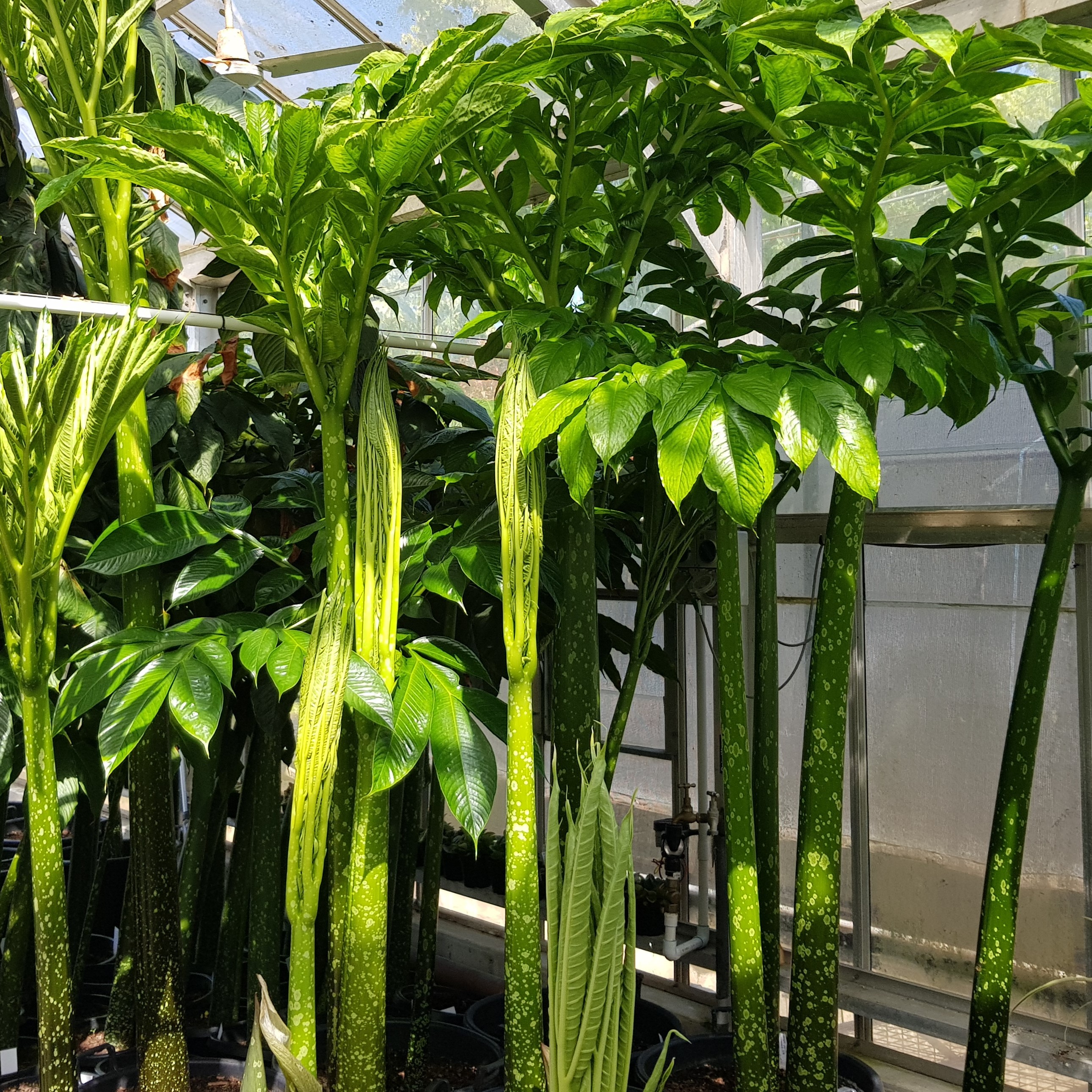
In the first stage, the plant emerges out of the ground to form a tree-like structure, which is actually a huge leaf with small leaflets branching off it.
This large leaf gathers energy through photosynthesis, and stores it in the plant's tuber which is hidden under the soil, similar to a potato. These tubers can get to enormous sizes - even as heavy as 150kg!
After 12-18 months, the plant's leaf structure will collapse and lay dormant for up to a year before repeating the process once again, giving its tuber another energy boost.
Once the tuber has stored enough energy - this can take up to ten years for the first flower - instead of producing a leaf, it will produce a flower bud.
A recent study on Amorphophallus species – including Titan Arum - found an interesting case of mimicry. To avoid their tender, juicy leaflets (rachis) and stem (petiole) being munched by herbivores, many species develop marks on their stem that look like lichens, making it look like an unappetising woody tree trunk.
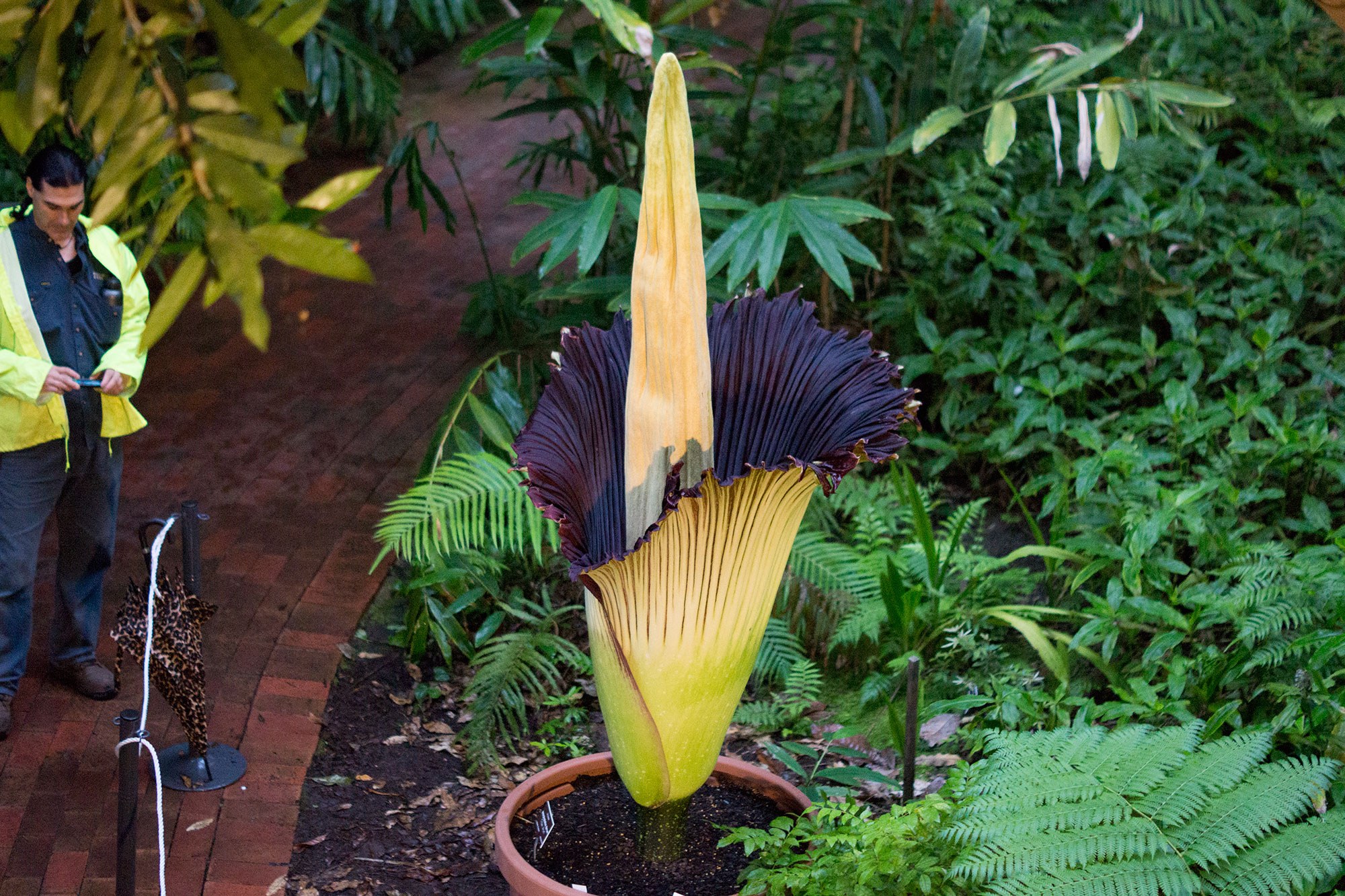
Once in a flowering cycle, the Titan Arum will emerge from the ground, shooting up a bud structure that can reach two metres tall.
When it opens, it looks like a large flower, but is actually an inflorescence. This is made up of a dark crimson petal-like structure called a spathe, which is actually a modified leaf. In the centre of that is a tall pointy part called the spadix. At the bottom of the spadix, hundreds of the tiny real flowers are hidden within. The plant produces both female and male flowers.
Once the plant has produced its first inflorescence, it can take three to five years for another flower to emerge - it's a very slow process, which makes flowering events so rare and exciting.
The plant is famed for its revolting smell, which has been likened to smelly feet, stinky cheese and dead animals. Indonesians know the plant as Bunga Bangkai, which means corpse flower, and is where its common name came from.
The stench is a tactic to attract pollinators who just love feasting on rotting flesh: carrion beetles, sweat bees and flesh flies.
The plant only produces the smell at night - which is when these insects are out and about - but it only smells for the first two nights, with the first 12 hours being the most pungent.
Using energy in in its underground tuber, the spadix (the tall spikey part) heats up to 37C and pulses the scent out from the plant like a spritz of nasty perfume. The smell is strong enough to spread a long distance - as far as 5km - so it is detected by insects a long way away.
In their hunt for a meal, pollinators travel to the plant. If they are already covered in pollen from a different corpse flower, they will dust its pollen onto the female flowers, which open on the first night. This is where the seeds are made.
On night two, the male flowers open and expose their pollen. Insects get covered in the pollen and take it to another stinky corpse flower, which hopefully has some female flowers open ready to be pollinated.
This means that for pollination to be successful, plants need to flower two or three days apart, and within a short distance from each other.
Once fertilised, the female flowers will start to make seeds which will be covered in juicy red fruit in about nine months' time.
Rhinocerous hornbill birds love to gobble them up, then poop out the seeds somewhere else in the forest, giving the plant a chance to grow elsewhere.
After a few days of blooming, the inflorescence of Titan Arum will start to collapse, eventually leaving just the the berry-like fruits on display.
If the plant sets seed, it will likely die. However, if the plant does not set fruit, it will then become dormant again, with the tuber waiting to start a new leaf cycle once again.
In cultivation, for Titan Arum to produce seed, its plants need to be hand-pollinated with pre-frozen (and then defrosted) pollen from a different plant....unless two flowers happen to open a few days apart from each other in which case fresh pollen can be used.
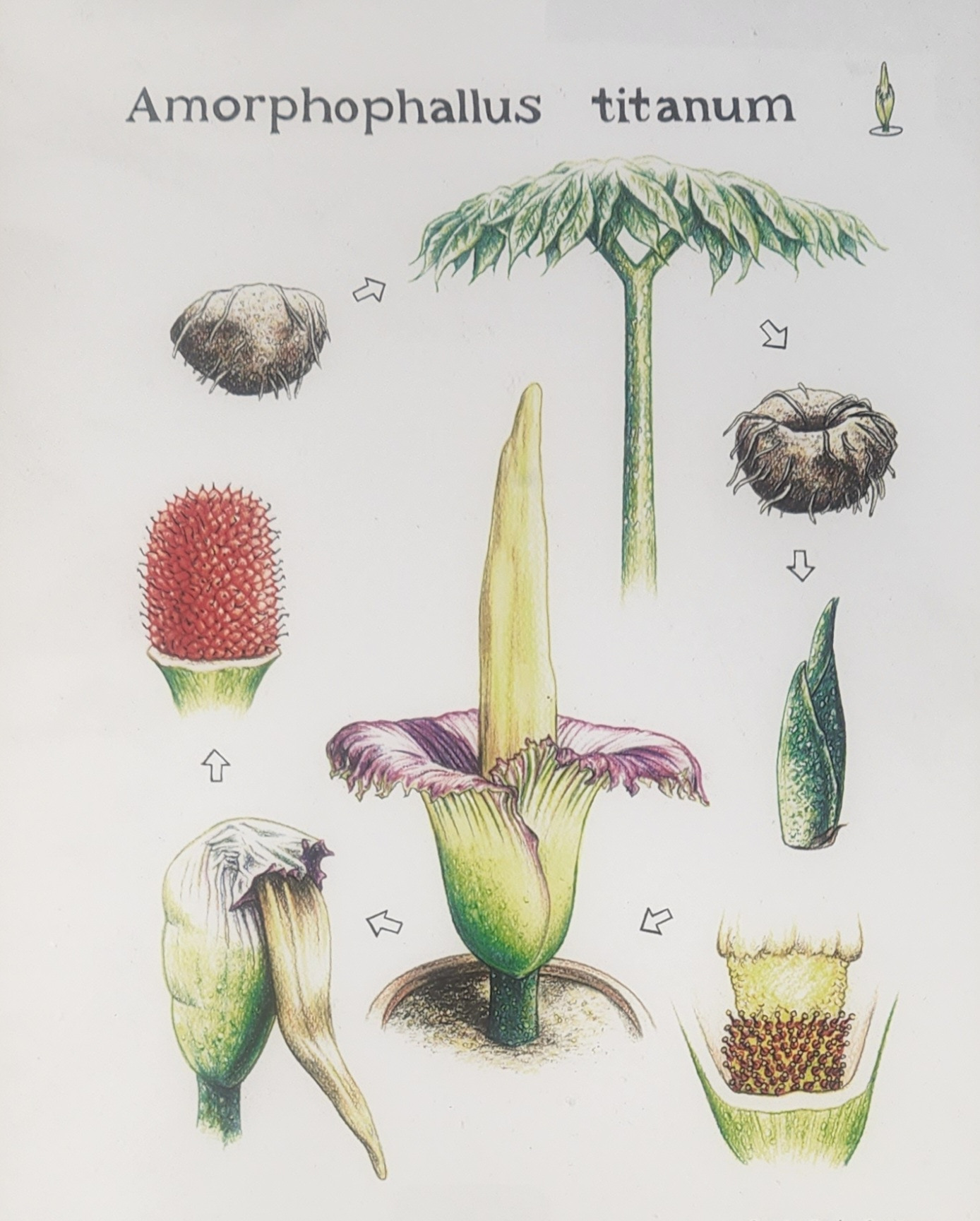
The corpse flower life cycle, illustration by Cosimo de Paolo
