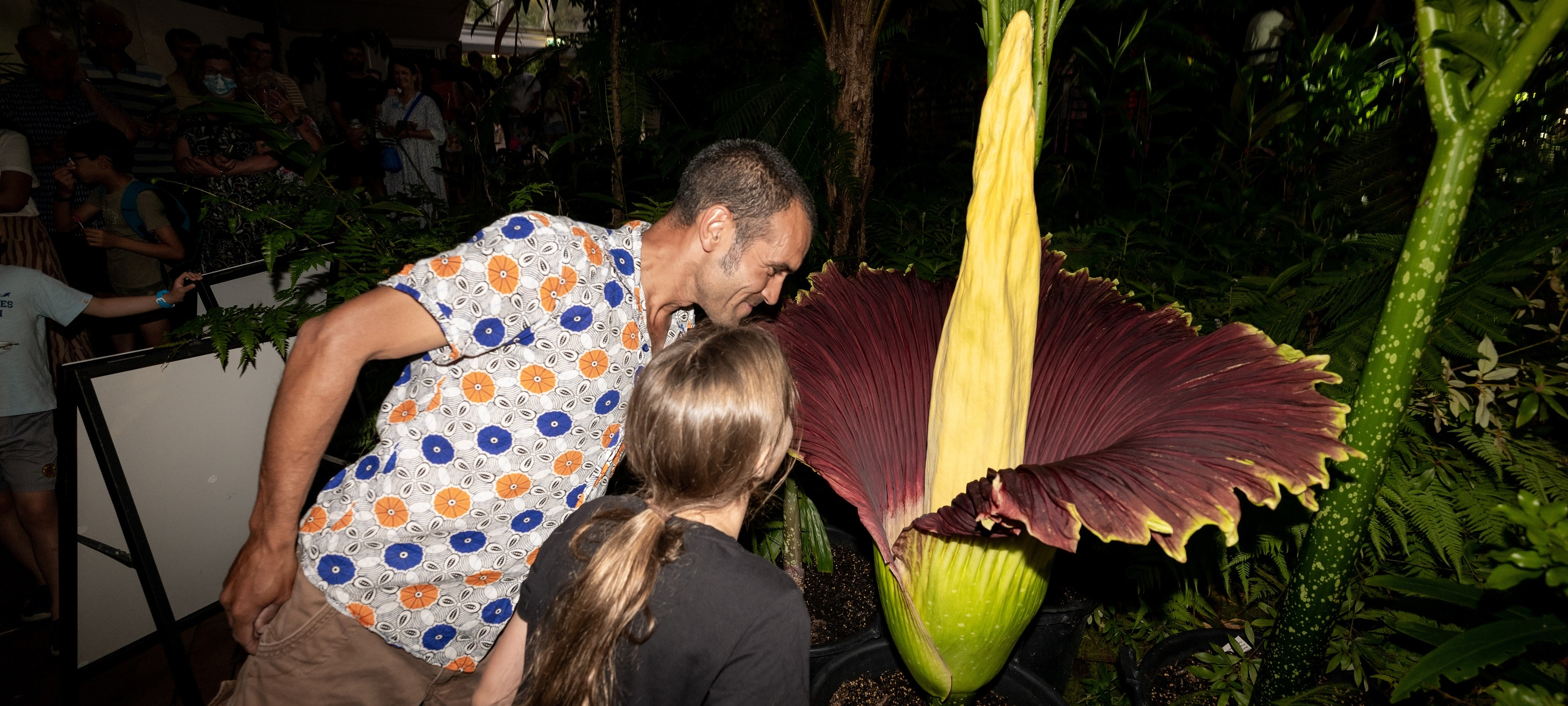
Visitors braving the smelly aroma in a corpse flower in 2023. Photo: Alexandra Drewniak
Renowned for its towering size, pungent aroma and fleeting appearance, the endangered plant drew around 7,000 thousand visitors keen to experience this rare botanical phenomenon.
Also known as the Titan Arum and Amorphophallus titanum, the Sumatran plant releases a distinctive scent often likened to rotting flesh.
The powerful odour peaks within the first 24 hours of flowering as the plant attracts pollinators, lasting for up to 48 hours. After this brief display, the striking yellow spadix begins to collapse.
Horticultural Curator at the Botanic Gardens and State Herbarium of South Australia (BGSH), Matt Coulter, said the bloom represents a significant milestone in a plant conservation journey that began two decades ago.
“We received a donation of three seeds in 2006, and from that small starting point have grown a collection of around 250 Titan Arum plants,” Mr Coulter said.
“Approximately 100 have been propagated from leaf cuttings and 150 through cross-pollination, in addition to the original three plants. This bloom has emerged from a tuber generated by one of those original seeds and marks the second time this particular plant has flowered, following its last bloom in 2021.”
Affectionately named by staff as Smellanie, the bloom reached a top of 2.13 metres tall, and highlighted the importance of long-term plant conservation efforts. Titan Arums are listed as endangered on the IUCN Red List, with fewer than 1,000 plants remaining in the wild.
Habitat loss from deforestation for palm oil plantations, illegal logging, theft and climate change continues to threaten the species, making the ex-situ conservation role of botanic gardens increasingly critical.
BGSH Director Michael Harvey said plant conservation is central to the organisation’s mission.
“BGSH works closely with botanic gardens and conservation-focused institutions across Australia and internationally to protect both Australian and exotic plant species,” Mr Harvey said.
“In the case of the Titan Arum, our horticultural experts have shared tubers, DNA samples, propagation techniques and research to help safeguard this remarkable species.”
“The growth of this collection, and the enjoyment it brings to the public, is a testament to the skill, dedication and expertise of our team.”
How do I find out more?
Updates on the corpse flower have been shared on our social media channels:
Explore more about the corpse flower here.
The Titan Arum is on display in the Bicentennial Conservatory (B5 on the map) in Adelaide Botanic Garden.
The Conservatory will be open as follows:
Wednesday 28 January: Open 10am - 4pm. Tickets will again be required to see the Wildlife Photographer of the Year exhibition.
Thursday 29 January: Smellanie has collapsed and will be removed from the Conservatory on Thursday. It will be taken back to the nursery where it will be cared for as it goes through its leaf cycle again and again. It may produce another bloom in the future.
Smellanie started blooming around 6pm on Friday 23 January.
It continued through Saturday 24 January and into Sunday 25 January, though its infamous smell had mostly gone by this point.
In the early hours of Monday 26 January, the spadix collapsed. The show was over!
On Thursday 29 January it is being returned to the nursery, also known as the Amorphophallus Palace!
Follow our social media channels for the latest news:
The Titan Arum is on display in the Bicentennial Conservatory (B5 on the map) in Adelaide Botanic Garden.
The Conservatory will be open as follows:
Wednesday 28 January: Open 10am - 4pm. Tickets will again be required to see the Wildlife Photographer of the Year exhibition.
Thursday 29 January: Smellanie has collapsed and will be removed from the Conservatory on Thursday. It will be taken back to the nursery where it will be cared for as it goes through its leaf cycle again and again. It may produce another bloom in the future.
Entry to Adelaide Botanic Garden is free, and it was free to see the Corpse Flower.
To help support the care of this remarkable plant and the ongoing conservation work of the Botanic Gardens and State Herbarium, we invite visitors to make a voluntary donation upon entry.
A suggested donation of $5 or $10 is greatly appreciated, with the option to give more if you wish.
Please note that the Wildlife Photographer of the Year exhibition is on inside the Conservatory, which is a ticketed event. Before and after the two main bloom days, those only wanting to see Smellanie can still do so for free however they will not be able to see the rest of the exhibition without a ticket. We invite any Smellanie visitors to make a voluntary donation.
Every contribution helps us continue to conserve the Titan Arum, as well as many other plants, including native Australian plants through our work at the SA Seed Conservation Centre, and the State Herbarium.
Tap and go machines will be available in the Conservatory, and are dotted throughout the garden. Cash donations will also be welcomed.
If you like, you can donate online:
There are six entrances to the Garden.
View our standard garden map here.
Public transport
Tram and bus stops are 150m from the Main Gate on North Terrace, Adelaide, noting these are the opposite side of the Garden to the corpse flower.
Car
There is ticketed parking available along Plane Tree Drive, but this will get very busy. Tickets are required up to 10pm.
Alternative parking is available along Hackney Road and in Adelaide’s East End.
Yes, there are toilets located throughout the garden. These all have accessible toilets, and there is a Changing Places facility in the Classground toilets.
Please see our map here.
Yes, you can bring food and drink into the Garden, but it cannot be consumed inside the Bicentennial Conservatory where the corpse flower is.
BYO alcohol is not permitted.
During regular opening hours food and drink will be available to purchase from Evergreen Café on the Schomburgk Pavilion in the centre of the Garden and at Evergreen To Go, located at the Friends Gate and start of the Corpse Flower queue.
You can also have a meal, or coffee and cake at Botanic Lodge.
There are water fountains in the garden, including outside the toilet block alongside the queue.
View our Accessibility Guide for Adelaide Botanic Garden here.
While queuing, if you require special assistance, please alert a member of staff.
Here is some additional information about this event specifically:
Seating
There will be limited seating available along the queue.
You are welcome to bring a fold up stool or camping chair to rest on in the queue if you need to.
Inside the Conservatory
The Bicentennial Conservatory contains a paved pathway at ground level and includes a low gradient sloped board walk to the upper level and low gradient sloped paved path on the ground level. These walkways will take you on a trail that is about 200m in length, and both walkways have full wheelchair access.
The queue to experience the Corpse Flower will take you on both of these pathways.
As this is a Rainforest environment, please be aware that there may be light ‘rain’ or moisture in the air from the misters. This can cause the pathways to be wet, and sometimes slippery.
If you have another inquiry about accessibility needs, please contact us at botanic.exhibitions@sa.gov.au
We will contact any ticket holders on bloom days to offer a refund of your Wildlife Photographer of the Year ticket, or to reschedule your booking for a different day. You are still welcome to experience the Corpse Flower and photography exhibition for free on the two bloom days, but will need to join the queue for the Corpse Flower to do so.
